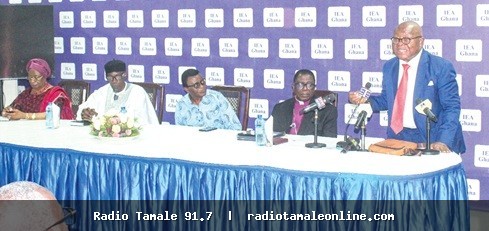
Both Christian and Muslim leaders have opposed the proposed extension of the country’s presidential term from four to five years.
They explained that the existing four-year electoral cycle provided sufficient time for elected governments to implement their programmes for the electorate to assess them.
They made their position known at a forum organised by the Institute of Economic Affairs (IEA) in Accra last Tuesday, where participants discussed the Prempeh Committee’s Constitutional Review Report and the government’s position on it.
Submitted in December 2025, the report recommended extending presidential and parliamentary terms from four to five years to improve governance continuity.
Among others, it also proposed lowering the presidential eligibility age while maintaining the strict two-term limit.
The government formally accepted the recommendations, but said it would not apply to the incumbent president.
Continuity
The President of the Africa Methodist Council, Most Rev. Dr Paul Boafo, who presented the Christian Council of Ghana’s position, said the proposed five-year presidential term was unnecessary, arguing that effective governance depended more on policy continuity than the length of an electoral cycle.
He said the council was particularly concerned about the abandonment of development projects when governments changed and, therefore, supported the establishment of an independent National Development Planning Commission (NDPC) to coordinate and monitor a binding long-term national development plan as proposed by the report.
“Even though the government rejected the proposal, here, we support the view of continuity.
The Church agrees wholly with the CRC's position on strengthening the NDPC. It is our belief that an independent NDPC will ensure continuity.
“We have all been here, and we know what has happened to us as a nation. One political party leaves office and all projects, all the governmental projects are left abandoned, and they go to waste,” he said.
Appointing powers
The council also called for a substantial reduction in the President’s appointing powers, particularly over independent constitutional bodies, and advocated greater participation by other stakeholders in such appointments.
Most Rev. Boafo further supported a stronger Parliament, independent constitutional institutions and an accountable judiciary. However, he rejected the proposed constitutional cap of 15 Supreme Court justices, arguing that the Court’s broad jurisdiction could leave it overloaded with cases.
Therefore, a cap could only be considered if the Court’s jurisdiction was adjusted accordingly.
Presidential term
The spokesperson for the National Chief Imam, Armiyawo Shaibu, also questioned the justification for extending the presidential term, saying the reasons advanced for a five-year tenure were not convincing enough.
He also opposed lowering the minimum presidential age from 40 to 30, saying national leadership required experience, exposure, maturity and the ability to make decisions during critical moments.
The spokesperson said there was a need for mentorship and preparation before assuming the highest office.
On the Electoral Commission, Mr Shaibu backed a merit-based and competitive appointment process, saying election managers needed to be credible and broadly accepted to sustain public confidence in electoral outcomes.
On corruption, he supported the strengthening of existing anti-corruption institutions rather than establishing another commission.
Sheikh Shaibu also backed implementation of measures requiring persons with unexplained increases in wealth to demonstrate legitimate sources of their assets.

0 Comments