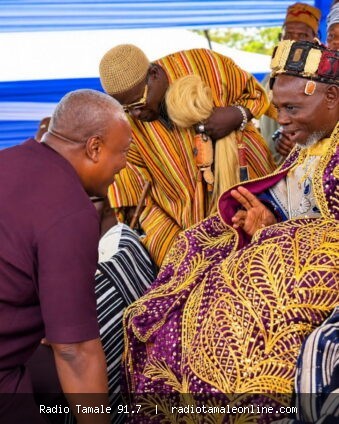
Once upon a time in the Republic of Uncommon Sense, a President went to a traditional festival, bent his knees before a chief, and accidentally opened a national debate about the constitutional responsibilities of the human kneecap.
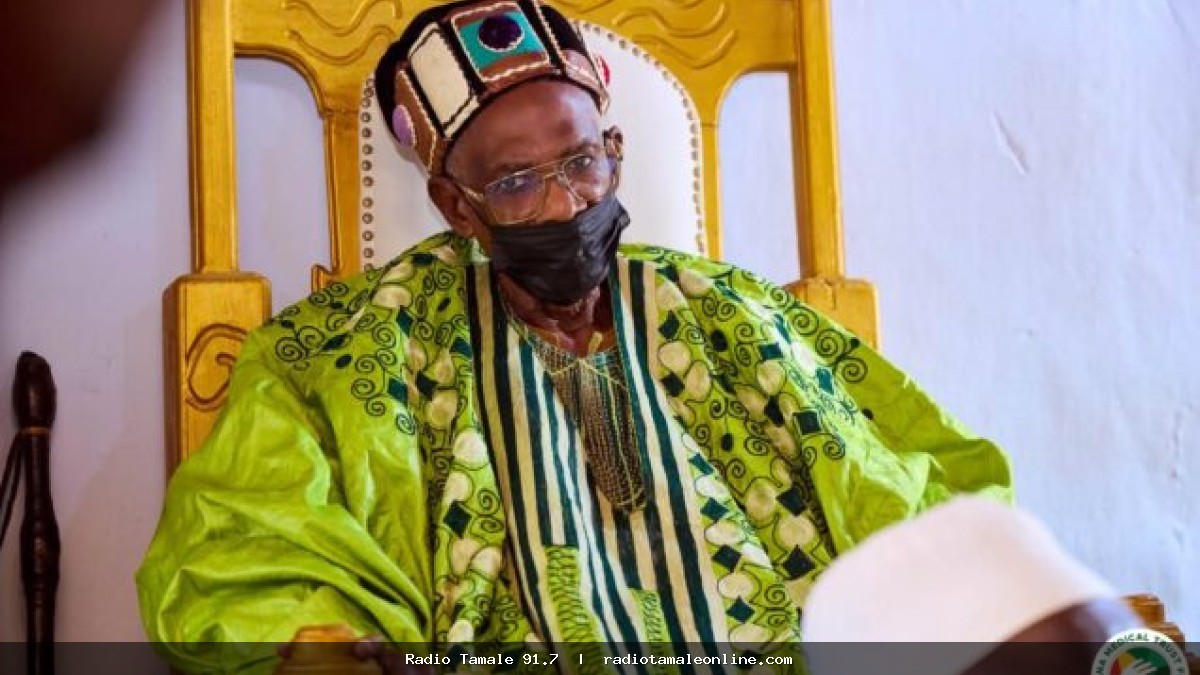
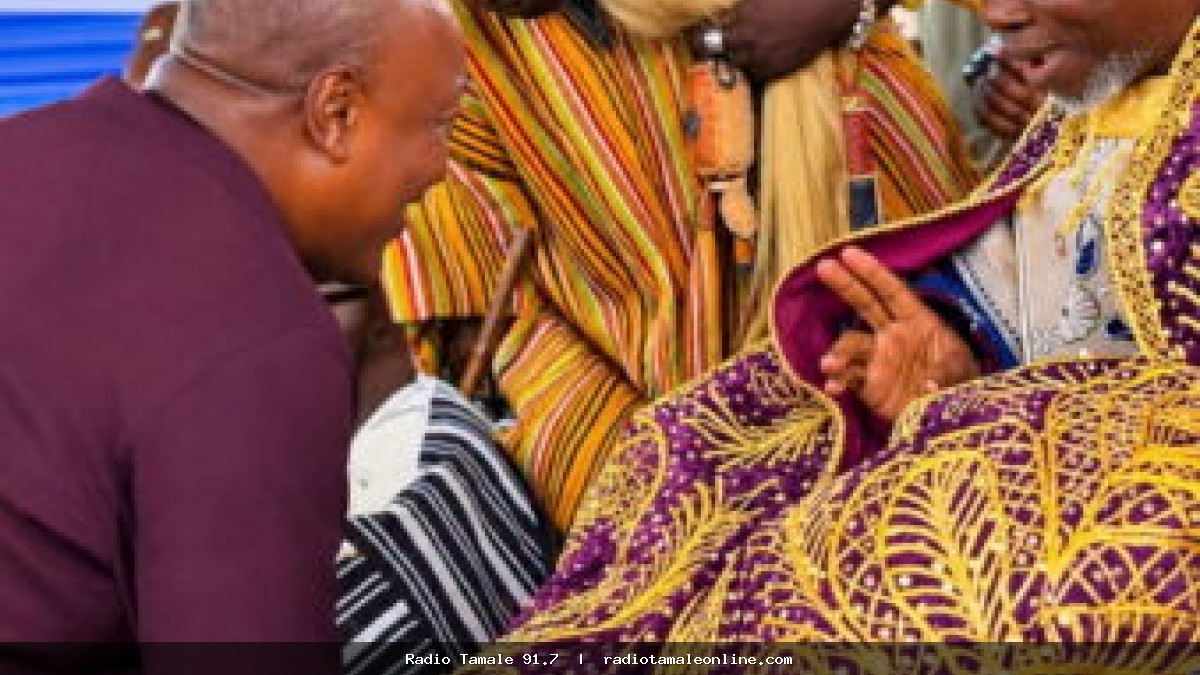
It happened at the Hogbetsotso Festival in Anloga, where President John Dramani Mahama bowed and knelt before the Yagbonwura, overlord of Gonjaland, who had travelled from the north as Special Guest of Honour of the Awoamefia, Togbi Sri III.
The cameras captured the moment, and before the President could straighten his trousers, Ghana's social media customary law experts had convened an emergency sitting.
Why did Mahama kneel before the Yagbonwura but not before the Awoamefia, who was hosting the festival? Was one chief more important than the other? Had the President distributed his respect unequally? And should the Awoamefia demand a supplementary kneeling ceremony to correct the apparent imbalance?
In Ghana, where every citizen with a smartphone is a constitutional lawyer, traditional historian and cultural anthropologist, such matters cannot be left unattended.
The difficulty, of course, is that Mahama is a son of Gonjaland. The Yagbonwura is his traditional overlord. Whatever office he occupies in Accra, the customs of his people do not automatically expire when he takes the presidential oath.
A man may become President of the Republic without becoming President of his ancestors.
The Anlo, however, have their own traditions. Their Awoamefia presides over a kingdom whose customs need not be identical to those of Gonjaland. Whether kneeling is required in a particular ceremonial setting is a question for the custodians of Anlo tradition, not for Facebook's newly appointed Inspector-General of Knees.
Our elders understood something modern Ghana appears to have forgotten. When a stranger enters a village, he learns how the people greet before deciding whether they have greeted him properly. He does not arrive with a measuring tape to determine whether their respect has reached the required depth.
But the controversy became even more entertaining when the internet remembered Nana Addo Dankwa Akufo-Addo.
Ah, Nana!
During his presidency, videos circulated showing him signalling seated chiefs to rise before exchanging greetings. The matter became so serious that the Ministry of Chieftaincy and Religious Affairs issued an explanation invoking Article 57(2) of the Constitution, which gives the President precedence over all other persons in Ghana.
Suddenly, standing to greet the President had acquired constitutional importance.
One could almost imagine a new department at the Presidency, responsible for monitoring the vertical positions of traditional rulers at public functions.
A chief seated when the President approached might receive a gentle reminder that the Constitution expected some cooperation from his knees.
The Ministry argued that this was about respect for the presidency, not disrespect for chieftaincy. Critics disagreed. Professor Raymond Atuguba questioned the interpretation, reminding the nation that traditional authority also enjoys constitutional protection.
And so Ghana discovered that the same Constitution could apparently be consulted by both the man demanding that chiefs stand and the chief wondering why he should.
Fast-forward to Anloga, November 2026.
A different President approaches a traditional ruler. Instead of asking the chief to rise, he himself goes down.
The internet immediately retrieves the old videos, places them beside the new footage and invites the nation to examine the evidence.
Yesterday, the controversy was about chiefs who would not stand. Today, it is about a President who knelt before one chief but did not kneel before another.
At this rate, the next constitutional amendment may require the Electoral Commission to publish the preferred greeting posture of every presidential candidate.
There is an old lesson in traditional leadership: the stool does not become taller because its occupant demands that everybody else stand. Neither does a ruler's authority diminish because someone greets him without kneeling.
Our ancestors knew that respect was not a competition in physical exercise. The chief who receives homage understands the language of his people. The visitor who offers homage must understand the customs of his host. Confuse the two, and you may end up demanding that a fisherman climb a tree to demonstrate his swimming skills.
The greater irony is that Hogbetsotso commemorates the Anlo people's historic escape from the oppressive rule of King Agorkorli of Notsie. It is a festival deeply associated with freedom, collective courage and the determination of a people to govern their own destiny.
Yet here we are, centuries later, arguing about the correct angle at which a free citizen should bend before authority.
And there is something else worth remembering. The Yagbonwura did not travel all the way from Gonjaland to Anloga to supervise a presidential kneeling competition. He came to celebrate friendship between traditional kingdoms. The Awoamefia invited him as an honoured guest, not as a rival in a national championship of royal reverence.
The two traditional authorities were celebrating unity while their enthusiastic defenders were busy calculating who had received the greater quantity of respect.
Perhaps this is what happens when politics enters the courtyard of tradition. Every handshake becomes a manifesto. Every bow becomes a campaign advertisement. Every bent knee becomes evidence in the permanent trial of one political party against another.
There is nothing inherently disrespectful about a chief standing to greet a President. Neither is there anything inherently humiliating about a President kneeling before his traditional overlord. Context, custom and consent matter.
A chief who voluntarily rises has offered courtesy. A President who voluntarily kneels has offered homage. Trouble begins when either gesture becomes a compulsory examination in political loyalty.
The wisdom of our elders is that the head may wear the crown, but it must still remember the neck that carries it.
In the Republic of Uncommon Sense, however, we have developed a more sophisticated philosophy: when our preferred politician kneels, it is humility; when our opponent asks someone to stand, it is arrogance. And when the same politician fails to kneel before another chief, we immediately summon the traditional council of Facebook for disciplinary proceedings.
Perhaps the most useful lesson from Anloga is not how far Mahama bent his knees, or how firmly Akufo-Addo once expected chiefs to stand.
It is that political office is temporary, traditional institutions endure, and respect is better demonstrated through conduct than measured with a protractor.
After all, a President may spend four years standing above everybody and still leave office with little respect. Another may kneel for five seconds and spend the rest of his term being judged by what he does while standing.
Our elders would probably advise us to stop counting presidential genuflections and start counting presidential achievements.
But this is Ghana, where even the knees of the President must account to the nation.
And judging by the excitement on social media, the knees may soon require their own press secretary.
Source: Myjoyonline



0 Comments