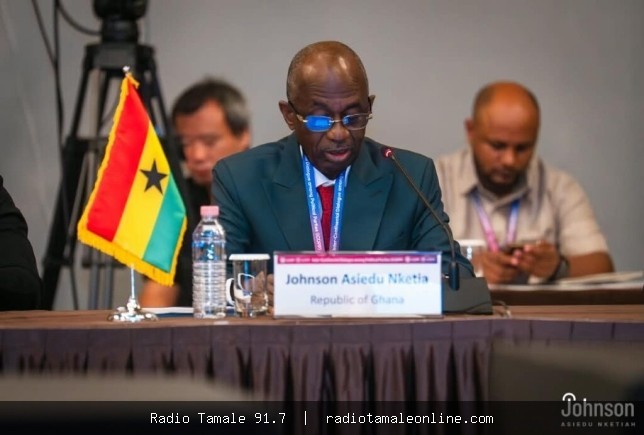
The National Chairman of the National Democratic Congress (NDC), Johnson Asiedu Nketiah, has urged political parties to adapt to changing societies, strengthen leadership development and make deliberate efforts to rebuild public trust.
He said political parties that failed to appreciate the depth of those changes risked losing the public confidence on which their political relevance depended.
He said this at the inaugural Inter-Continental Dialogue on Political Parties in Seoul, South Korea, where he addressed the gathering on behalf of political parties participating in the African Political Parties Initiative (APPI).
The event brought together the Africa Governance Centre (AGC), through APPI, the International Conference of Asian Political Parties (ICAPP) and the Permanent Conference of Political Parties of Latin America and the Caribbean (COPPPAL).
Identities
Mr Asiedu Nketiah said political institutions could no longer rely solely on historical identities, ideological traditions or generational loyalties to retain public support, as each generation increasingly expects political parties to demonstrate their relevance to contemporary social and economic realities.
He argued that political organisations once sustained by strong historical identities, ideological traditions or generational attachments could no longer assume those loyalties would automatically pass from one generation to another.
He said a party’s history might explain its position in national life but could not guarantee its future.
Mr Asiedu Nketiah pointed out that every generation encounters politics under different economic and social circumstances and ultimately makes its own assessment of whether existing political institutions remain relevant to the society it wants to build.
He said the judgement of citizens was becoming increasingly demanding, particularly among young people who have greater access to information and developments beyond their own countries.
The NDC chairman noted that many young people were simultaneously confronting unemployment, economic insecurity, rising living costs and uncertainty about whether education and hard work still offered a dependable route to economic advancement.
Economic hardship
Mr Asiedu Nketiah also linked public trust in political institutions to citizens’ everyday experiences.
He said dissatisfaction could deepen when people felt they had fulfilled their responsibilities to society working, obeying the law, raising families and making sacrifices for their children yet remained unable to see a realistic path towards a better standard of living.
In such situations, he argued, frustration could move beyond dissatisfaction with individual policies and develop into broader scepticism about political institutions.
He, therefore, urged political leaders to treat such developments as an institutional warning rather than dismiss them as temporary public discontent.
Source: Graphiconline








0 Comments