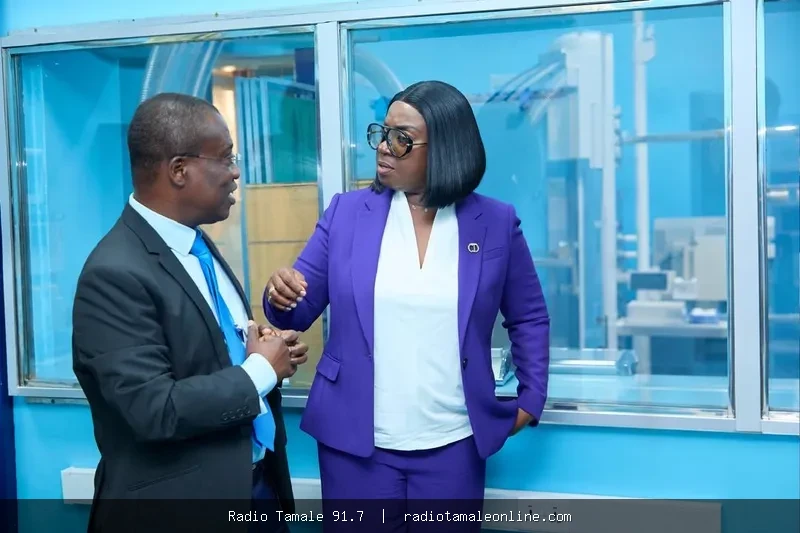
In its first year, the Ghana Medical Trust Fund has provided lifesaving heart surgery for over 110 children and built a new cardiac cath lab at Korle Bu.
For more than 110 children, the first anniversary of the Ghana Medical Trust Fund (GMTF) is more than a milestone on the national calendar. It represents something far more precious: the chance to live.
A chance to return home to their parents. A chance to play with their friends, walk into a classroom, learn a vocation, pursue a dream, and grow into the men and women they were born to become.
That is the human story behind the numbers for Dr. Kow Entsua-Mensah, Head of the National Cardiothoracic Centre at the Korle Bu Teaching Hospital, as he reflects on the first year of the Ghana Medical Trust Fund.
More than 150 patients who otherwise faced enormous financial barriers to lifesaving cardiac treatment are being taken care of at the National Cardiothoracic Centre alone. About 110 of them are children.
For Dr. Entsua-Mensah, those figures raise a sobering question: What would have happened to these patients if the Fund did not exist?
Behind every number, he said, is a human being whose future could easily have been cut short simply because a family could not afford the cost of lifesaving treatment.
110 Children, 110 Futures
It is the children whose stories appear to resonate most deeply with the cardiothoracic surgeon.
For families confronted with the diagnosis of a serious heart condition in a child, the battle is often fought on two fronts: against the disease itself and against the financial cost of treatment.
The intervention of the Ghana Medical Trust Fund is changing that reality for scores of families.
Dr. Entsua-Mensah looks beyond the operations and hospital beds to the futures now being reclaimed.
These children, he believes, "will grow stronger, play with their peers, return to school, pursue education and vocational training, and eventually contribute to Ghana's development."
And then comes the question that perhaps captures the significance of the intervention better than statistics ever could: Who knows what these children will become?
Among them could be Ghana's future doctors, teachers, engineers, entrepreneurs, artists, and national leaders.
Without treatment, some of those possibilities could have disappeared before they ever had the opportunity to unfold.
From a Devastating Fire to More Than 60 Lives Saved
The impact of the Trust Fund at the National Cardiothoracic Centre goes beyond paying for patients' treatment.
In 2025, fire ravaged the Centre's cardiac catheterisation laboratory, a critical facility for diagnosing and treating complex heart conditions.
By the end of July 2026, the Ghana Medical Trust Fund had replaced the destroyed facility with a state-of-the-art cardiac catheterisation centre.
Since the new facility opened, more than 60 patients have undergone complex lifesaving procedures there, with many more patients lined up for treatment and emergency cases continuing to be managed.
During the Trust Fund's initial 50-case pilot, designed to test its systems, 15 patients were sponsored to undergo lifesaving procedures at the National Cardiothoracic Centre.
Today, that intervention has expanded dramatically, with more than 150 patients onboarded for care at the Centre.
An Investment in Humanity
For Dr. Entsua-Mensah, the significance of the Ghana Medical Trust Fund cannot be measured only in cedis, equipment purchased, or procedures performed. It must also be measured in lives restored and hope returned to families.
"Adults whose illnesses had taken them away from their normal lives and livelihoods now have an opportunity to receive treatment and return to work. Children whose futures were threatened by serious heart conditions have an opportunity to grow and pursue their aspirations," he added.
He describes the intervention as "a great investment in humanity" an investment in the restoration of lives and, importantly, the restoration of hope.
Perhaps one of the Trust Fund's most significant achievements, he observed, is the renewed confidence it is creating among ordinary families: the assurance that falling seriously ill does not necessarily mean a patient's survival must depend solely on how much money that patient or family can raise.
Through the Ghana Medical Trust Fund, he said, people can increasingly have confidence that the state has an instrument through which it can come to their aid when they face critical illness.
Taking Lifesaving Heart Care Closer to Ghanaians
The transformation Dr. Entsua-Mensah sees is not confined to Korle Bu. He pointed to the development of cardiology centres at the Komfo Anokye Teaching Hospital in Kumasi and Tamale Teaching Hospital as another important part of the emerging national cardiac-care network.
For decades, patients with complex cardiac conditions have had to travel considerable distances to Accra for specialised treatment at the National Cardiothoracic Centre. The expansion of specialist cardiac infrastructure promises to change that.
Dr. Entsua-Mensah said the National Cardiothoracic Centre would be able to collaborate with its counterparts in Kumasi and Tamale, mentor and train professionals there, and extend specialist services beyond Accra.
Ultimately, patients from those parts of the country would no longer necessarily have to travel to the capital for treatment. Lifesaving cardiac care, he said, is being brought closer to the people. And he believes Kumasi and Tamale could only be the beginning, with specialist services eventually extending to other parts of Ghana.
A Dream Beginning to Unfold
One year into the existence of the Ghana Medical Trust Fund, Dr. Entsua-Mensah believes something long imagined within Ghana's specialist healthcare system is finally beginning to take shape.
"For the first time, what we have dreamt of, what we had hoped for, is beginning to unfold right before our eyes."
But perhaps the most compelling evidence of that unfolding dream will not be found in buildings, machines, or statistics.
It will be found in a child returning to school after heart surgery.
In parents who once feared they might lose their child but can now watch that child run and play again.
In an adult returning to work after illness threatened a family's livelihood.
And in the more than 110 children currently being given something no amount of money can truly measure: another chance at life and the opportunity to become whatever their dreams allow them to be.
Source: GMTF


0 Comments