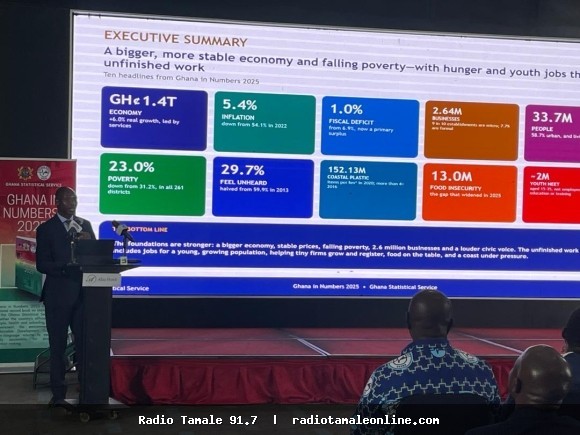
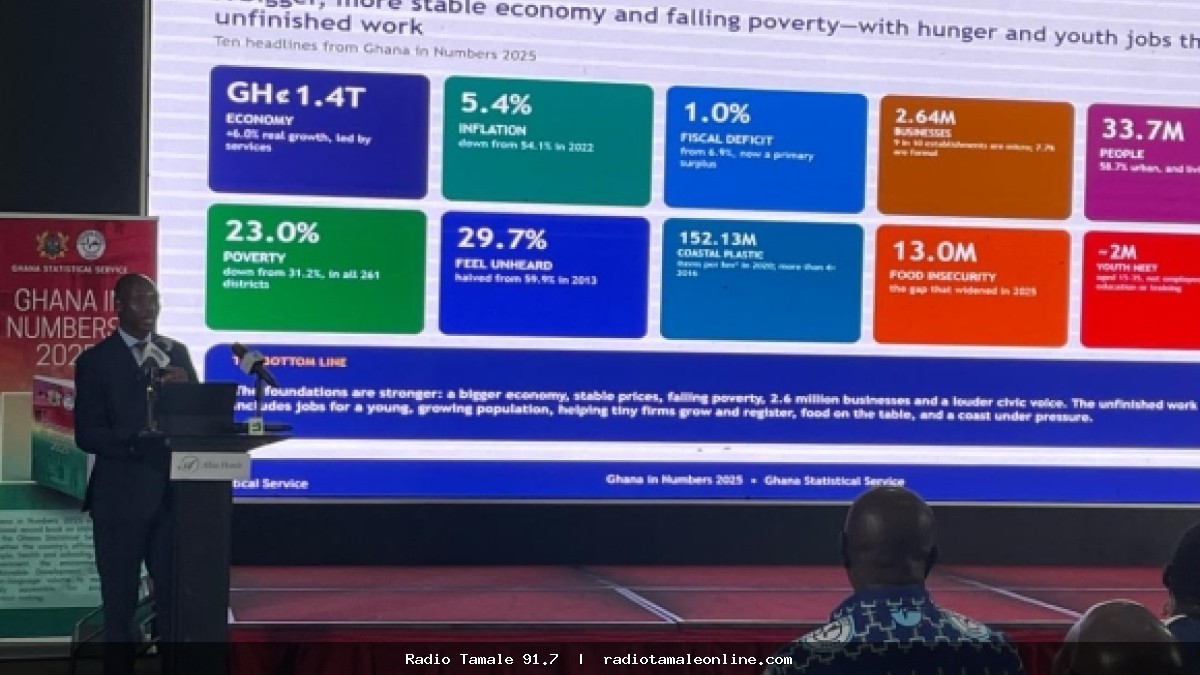
The Ghana Statistical Service (GSS) has launched Ghana in Numbers 2025, a maiden flagship publication that brings together official statistics on the country and demonstrates how they can inform decision-making.
The publication presents key figures on population, social development, the economy and businesses, governance, the environment and the Sustainable Development Goals, showing for each indicator the figure, its trend and what it means.
It is intended to give decision-makers and the public a shared set of figures for planning and tracking progress, and is accompanied by a web portal featuring district-level data, interactive maps and downloadable resources, as well as a pocket edition.
Progress
The Government Statistician, Dr Alhassan Iddrisu, highlighted progress in areas such as inflation, poverty, child mortality, life expectancy and citizens' reported participation in government decisions. He explained that the figures are intended to help track Ghana's progress towards national and international development goals.
"When we have our cabinet, parliament, boardrooms, and newsrooms working from the same figures, the debate moves from whose figures are right to what do we do about them," he stated.
Dr Iddrisu emphasised ongoing challenges, noting that unemployment eased to 12.8 per cent in 2025, but more than seven in ten jobs remained informal. Nearly two million young people were not in education, employment or training, and more than six in ten of them were young women.
"Ghana's youth window is open, but it is closing. Our choices on schooling, skills, and jobs in the next 10 years will decide whether it becomes a dividend or a burden," he added.
He expressed gratitude to the Minister of Finance for allocating GH¢207 million in the 2026 financial year to rebase Gross Domestic Product and the Consumer Price Index and fund related activities. He called for this support to continue in future budgets so Ghana's statistical work can rely on predictable domestic funding rather than external funding cycles.Buy Maps
Reliable statistics
The Governor of the Bank of Ghana, Dr Johnson Pandit Asiama, said the publication can help policymakers, businesses, researchers, development partners and the public understand Ghana's progress, identify challenges and make informed decisions. He emphasised that reliable, timely statistics are essential to the Bank of Ghana's monetary policy and financial regulation.
"Reliable statistics do more than inform policy alone. They strengthen transparency, they enhance accountability, and promote public confidence in institutions," he said.
To make the publication more useful, Dr Asiama proposed "making the underlying data series available through a dedicated electronic portal in accessible, machine-readable, and readily usable formats."
Credible numbers
The Deputy Minister for Finance, Thomas Nyarko Ampem, said reliable statistics were essential to accountable, data-driven economic governance. He noted that the publication would serve as a tool to help the country understand its challenges and make better-informed decisions. "Credible numbers do not tell us what we want to hear, but they tell us what we need to know," he stated.
The Deputy Minister explained that Ghana's growing and youthful population offers significant potential, but youth unemployment, reported at 21.9 per cent, underscores the challenge of turning that potential into a demographic dividend. He emphasised quality education, relevant skills, productive investment and decent jobs as necessary to help young people contribute to the economy.
He called reliable statistics "national infrastructure" and urged public institutions to use and safeguard credible data. He committed that the Ministry of Finance "will work with the Ghana Statistical Service towards more predictable domestic funding for its core programmes," emphasising that "Ghana must take greater ownership of financing its essential statistics."
Source: Graphiconline







0 Comments