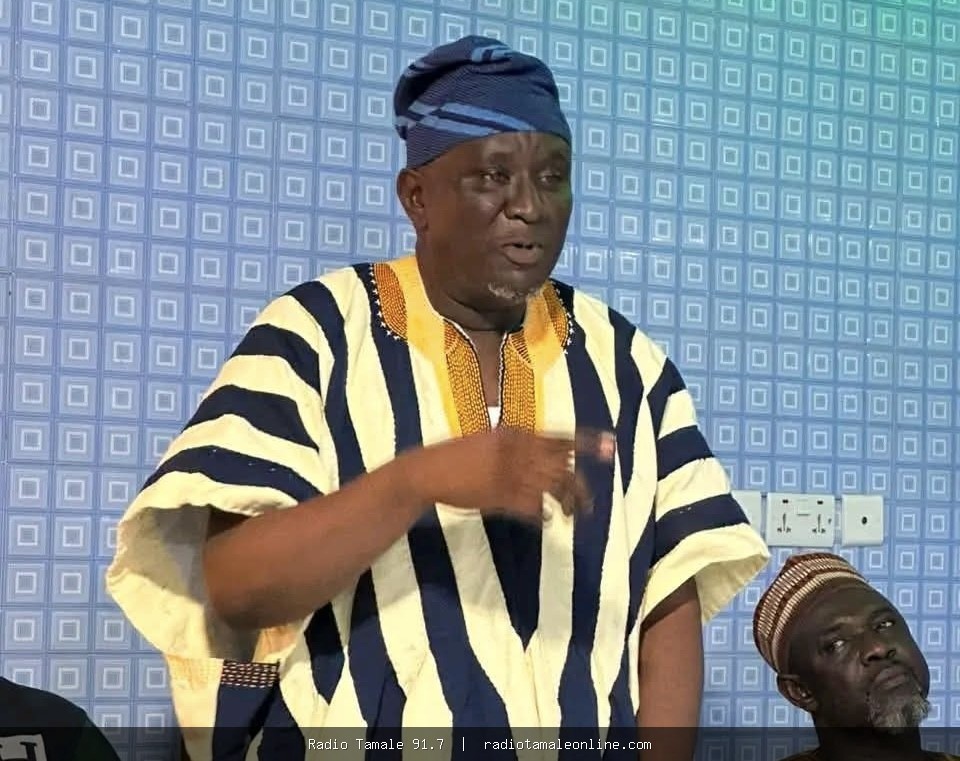
An analytical assessment of the strengths, weaknesses and electoral prospects of Number 2 on the ballot
In every political contest, there is often a tendency to mistake political influence for electoral invincibility. The presence of influential personalities behind a candidate can create an impression that the outcome is already predetermined.
Yet, the history of internal party elections, particularly within the National Democratic Congress (NDC), demonstrates that political endorsements, established alliances, and campaign machinery do not always translate into victory at the ballot box.
As the NDC Northern Regional executive elections approach, the contest for the regional chairmanship is shaping up to be an interesting three-way battle involving Godfred Apasinaba Sulemana Wumbei, popularly associated with the number one position on the ballot; Alhaji Tanko Maida, number two; and the incumbent Regional Chairman, Alhassan Abdul-Hamid, number three.
On the surface, the contest appears to present three different political propositions: Wumbei's political experience and grassroots connections, Maida's perceived association with an influential political establishment, and Abdul-Hamid's advantage of incumbency.
However, beyond these obvious political considerations lies a more complicated electoral calculation. The real question is not necessarily who has the most influential personalities behind him, but who has successfully cultivated the confidence of the delegates who will ultimately determine the next regional chairman.
It is within this context that Alhaji Tanko Maida's candidacy deserves serious consideration. Despite the formidable political personalities associated with his campaign, and the expectations that accompany such backing, Maida should neither be regarded as an automatic winner nor underestimated as a candidate whose electoral prospects are already secured.
Indeed, there are compelling reasons why he remains a formidable contender.
The Haruna Iddrisu factor: A formidable political advantage
One cannot adequately analyse the dynamics of the Northern Regional chairmanship contest without examining the political influence associated with Hon. Haruna Iddrisu, one of the most influential political figures to emerge from the Northern Region.
Alhaji Tanko Maida is widely perceived within the political conversation surrounding this contest as enjoying the backing of Haruna Iddrisu and his political camp. If this perception accurately reflects the level of support and mobilisation behind his candidacy, it constitutes a significant political advantage.
In Ghanaian politics, influential political figures do not merely provide endorsements. Their networks can facilitate political mobilisation, strengthen communication, improve access to delegates, coordinate campaign activities and create a sense of electoral momentum.
For Alhaji Maida, the association with such an established political network could prove particularly important in a regional election where personal relationships, political loyalties and established alliances often influence delegate decisions.
More importantly, the influence of Haruna Iddrisu extends beyond his immediate political constituency. His political history, national stature and relationships within the NDC establishment make his perceived involvement in the contest a factor that cannot simply be dismissed.
Nevertheless, there is an important distinction between having the backing of a political heavyweight and possessing the independent electoral strength required to win a regional election. Political influence can open doors, but delegates must still be persuaded to walk through them.
This is where Alhaji Maida's real electoral test begins. He must demonstrate that his candidacy is not merely an extension of an influential political camp but a credible leadership proposition in its own right.
He must convince delegates that he possesses the personal qualities, organisational capacity and political maturity necessary to lead the Northern Regional party structure.
His association with Haruna Iddrisu may provide the political platform, but his own credentials must provide the reason for delegates to vote for him.
One of the strongest arguments in favour of Maida is that his candidacy is not entirely dependent on external political influence.
He has served as a co-opted member of the Northern Regional Executive Committee, a position that has afforded him exposure to the internal workings of the party and an opportunity to understand the challenges confronting the regional leadership.
In his public declaration of his chairmanship ambition, Alhaji Maida identified three central priorities: party unity, consolidation of the NDC's support base and increasing the party's parliamentary representation in the region.
These are not insignificant campaign themes. They speak directly to the organisational and electoral challenges confronting the NDC as it prepares for the next general election.
Alhaji Tanko Maida has also spoken about the need to strengthen relationships between the regional executive committee and constituency structures, arguing that there should be more consistent engagement to understand and address grassroots concerns.
His position is particularly interesting because regional chairmanship is not simply a ceremonial political office. It requires the capacity to coordinate constituency executives, manage competing interests, resolve disagreements and maintain a functional relationship between the regional and national party structures. His experience as a co-opted regional executive member gives him some familiarity with these responsibilities.
Another important strength is his potential to benefit from political networks that extend beyond individual constituencies. In an election involving delegates from different parts of the region, the ability to mobilise support across established political structures can be decisive.
Furthermore, Alhaji Maida's relatively clear campaign message around unity and consolidation could resonate with delegates who believe the party requires stronger internal coordination ahead of 2028.
The NDC cannot afford to approach the next general election with a divided regional structure. It needs a chairman who understands that the party's electoral strength depends significantly on the effectiveness of its constituency organisations.
If Maida can translate these campaign promises into a convincing practical agenda, he could attract support beyond the political camp with which he is associated.
When political backing becomes a burden
For all the advantages associated with Alhaji Maida's candidacy, there are also vulnerabilities that his campaign must confront. The first is the danger of overdependence on political endorsement.
Although the backing of an influential political figure can strengthen a candidate's chances, it can also create a perception that the candidate is being propelled into office by political patronage rather than his own leadership credentials.
This perception may not necessarily reflect Alhaji Maida's actual capacity, but politics is often influenced as much by public perception as by objective realities.
Some delegates may question whether electing him would produce an independent regional chairman capable of making decisions in the broader interest of the party or reinforce the influence of an already powerful political establishment.
The question, therefore, is whether Alhaji Maida can successfully separate his personal leadership identity from the political influence associated with his candidacy.
His campaign must establish that he is seeking the chairmanship to serve the entire NDC in the Northern Region, not simply to consolidate the influence of a particular political camp.
The second weakness concerns his experience in the party's regional executive hierarchy.
While his position as a co-opted member has provided valuable exposure, it is different from having occupied the substantive regional chairmanship or another major elected regional executive position.
Delegates who prioritise administrative experience may reasonably ask whether he has demonstrated sufficient leadership capacity to manage the complexities of the office.
His campaign must therefore provide convincing evidence of his contributions to the party and demonstrate how those experiences have prepared him for the responsibilities ahead.
Thirdly, Alhaji Maida must contend with the challenge of converting political influence into genuine delegate loyalty.
The Northern Region is politically diverse, and the NDC itself accommodates different political interests, alliances, and tendencies. A candidate may enjoy the support of a prominent political establishment without necessarily commanding unanimous loyalty among delegates associated with that establishment.
Even within political camps, individual ambitions, personal relationships and constituency considerations can influence voting decisions.
This makes it dangerous to assume that the endorsement of influential figures automatically guarantees a corresponding number of votes.
Chairman Yellowman's challenge: The grassroots factor cannot be ignored
While much of the political conversation may revolve around Maida's perceived political backing and the incumbent's position, Godfred Apasinaba Sulemana Wumbei, number one on the ballot, presents a different kind of electoral challenge.
Chairman Yellowman's political history makes him a candidate who should not be casually dismissed.
The 2022 Northern Regional chairmanship election provides an important reference point. He polled 236 votes against Ali Adolf John's 247 votes, losing by just 11 votes. That result demonstrated that he had already built a substantial support base among delegates.
A candidate who comes within 11 votes of winning a regional chairmanship election cannot reasonably be classified as politically insignificant.
His previous electoral performance suggests that he understands the internal dynamics of the party and has established relationships that could remain relevant in the current contest.
Unlike a candidate whose political relevance is largely associated with influential endorsements, Wumbei can draw attention to his previous electoral performance as evidence of his capacity to compete.
However, his biggest challenge is whether he can retain his previous support base while attracting new delegates. He must also overcome the perception that repeated attempts at the same position without success could indicate a political ceiling.
Nevertheless, his candidacy represents an important reminder that the delegate electorate is not always predictable.
If delegates begin to prioritise personal relationships, independent leadership, grassroots accessibility and the desire for a different political direction, Wumbei could become more competitive than his public political profile might suggest.
His challenge is to convert his previous electoral strength into a broader and more effective coalition.
Alhassan Abdul-Hamid {Chairman Gbewaa}: The advantages and vulnerabilities of incumbency
The incumbent Regional Chairman, Alhassan Abdul-Hamid, number three on the ballot, occupies a particularly interesting position.
Incumbency is a powerful political asset, especially in internal party elections.
Having occupied the chairmanship, Abdul-Hamid has the advantage of institutional familiarity, established relationships and direct experience with the regional party administration. He also has the opportunity to campaign on his record rather than simply presenting promises about what he intends to accomplish.
However, incumbency is not always an advantage.
It comes with the responsibility of defending the performance of the office. Delegates are entitled to ask whether the regional party structure has become more effective under his leadership, whether constituency executives have received adequate attention, whether internal disagreements have been successfully managed and whether the party is better positioned for the 2028 elections.
An incumbent must answer these questions convincingly.
There is also the possibility that some delegates may desire a different leadership approach, particularly if they believe the regional party structure requires stronger engagement, renewed energy and a more inclusive administrative culture.
For Abdul-Hamid, therefore, the central challenge is to demonstrate that his experience in office has translated into measurable benefits for the party.
The mere fact of occupying the chairmanship does not automatically guarantee another mandate.
The real electoral mathematics: What will decide the contest?
Perhaps the greatest mistake political observers can make in this election is to judge the candidates solely by the personalities surrounding them.
Internal party elections operate according to a different political logic from general elections.
The electorate is smaller, the relationships are more personal, and individual delegates often have direct interactions with the candidates.
A delegate may respect Haruna Iddrisu but still make an independent decision about whom to support. Another may appreciate the incumbent's experience but desire a change in leadership. Yet another may prefer a candidate whose personal relationship with constituency executives is stronger.
This is why the actual electoral mathematics may be considerably different from the public political narrative.
For Maida, the most important consideration is whether his perceived political backing can translate into support across all 18 constituencies of the Northern Region.
He must also attract delegates who are not necessarily aligned with the political camp associated with his candidacy.
For Wumbei, the challenge is to consolidate his previous support and persuade new delegates that he represents a credible alternative.
For Abdul-Hamid, the challenge is to demonstrate that his record in office justifies another term.
Ultimately, the election may be determined by three interconnected factors: the strength of constituency-level mobilisation, the ability to build cross-factional alliances and the confidence delegates have in each candidate's capacity to unite the party after the elections.
Why Maida should not be underestimated
Despite the weaknesses identified, it would be a mistake to underestimate Alhaji Tanko Maida.
His candidacy brings together political influence, exposure to the regional executive structure and a campaign message that addresses some of the fundamental organisational needs of the NDC.
His perceived association with Haruna Iddrisu's political camp provides a formidable mobilisation advantage. His experience as a co-opted regional executive member gives him some understanding of the party's internal challenges. His emphasis on unity and constituency engagement also provides a foundation upon which he can build a broader leadership appeal.
More importantly, the presence of two other credible contenders means that the contest cannot be reduced to a straightforward transfer of political influence from one camp to the ballot box.
The incumbent has his own political considerations, while Wumbei has demonstrated that he can command a significant number of delegates.
Consequently, Maida's campaign must be judged on its ability to bring these different political considerations together.
He must not allow the perception of political endorsement to substitute for direct engagement with delegates. He must not assume that political loyalty to influential personalities automatically translates into loyalty to his candidacy.
Above all, he must communicate a convincing vision of how his leadership would benefit the entire party.
The Northern Region NDC needs more than a chairman who can win an election. It needs a chairman who can manage political differences, strengthen constituency structures, promote internal democracy and position the party for victory in 2028.
If Maida can convincingly establish himself as that kind of leader, his candidacy could become even more attractive to delegates who may not necessarily belong to the political camp associated with him.
Who can unite the Northern Region NDC?
Beyond the individual ambitions of the three contenders, the election presents the NDC with a much bigger question about the future of its political organisation in the Northern Region.
The party must decide whether its next regional chairman should primarily be someone with strong political connections, someone with the experience of incumbency or someone offering a different leadership proposition.
Ideally, the successful candidate should possess elements of all three.
The next chairman must be politically connected enough to engage national leadership, experienced enough to understand party administration and sufficiently accessible to maintain the confidence of grassroots executives.
He must also understand that the regional chairmanship is not an instrument for rewarding political loyalty or consolidating the influence of a particular faction. It is a responsibility that requires impartiality, maturity and the ability to accommodate competing interests.
This consideration is especially important because whoever emerges victorious will inherit a party comprising supporters of different political personalities and tendencies.
The chairman must therefore be prepared to lead even those who did not vote for him.
For Maida, this presents both an opportunity and a responsibility. If he wins, he must demonstrate that his leadership belongs to the entire NDC in the Northern Region. If he loses, his political relevance should not be measured solely by the outcome of the election.
The same principle applies to the other contenders.
Conclusion: The ballot box, not the political noise, will decide
Alhaji Tanko Maida, number two on the ballot, enters this contest with significant political advantages, particularly the perceived backing of Hon. Haruna Iddrisu and his political establishment.
But he also faces expectations that come with such an association. He must prove that he is more than a candidate backed by influential personalities. He must demonstrate that he can command independent respect, build consensus and provide effective leadership.
Chairman Yellowman's previous electoral performance makes him a credible challenger, while Abdul-Hamid's incumbency provides him with institutional advantages that cannot be ignored. There is, however, no certainty that any of these advantages will automatically translate into victory.
The political reality is that the loudest campaign is not necessarily the strongest at the polling station. The candidate with the most influential supporters is not necessarily the candidate with the greatest number of committed delegates. And the incumbent is not necessarily the favourite simply because he already occupies the office.
In the final analysis, the Northern Regional chairmanship election will be a test of political organisation, personal relationships, delegate confidence and the ability to build an electoral coalition.
Alhaji Maida has the political network. Wumbei has a demonstrable history of electoral competitiveness. Abdul-Hamid has the experience of incumbency. The question is which of these advantages will prove most persuasive to the delegates.
For now, one thing is certain: Alhaji Tanko Maida should neither be declared the winner before the election nor underestimated because of the challenges associated with his candidacy.
In politics, influence may open the door, experience may earn respect, and grassroots connections may build loyalty. But when the ballot is cast, it is the delegates who decide who walks through the door.
And that is why Number 2 on the ballot remains a candidate to watch.
Authored By: Robicon Mornahson



0 Comments