Ghana is seeking to address persistent gaps in fisheries and oceans data through a new cooperation programme with Norway aimed at strengthening scientific research, modernising data systems, and improving the management of the country’s marine resources.
The Minister for Fisheries and Aquaculture, Hon. Emelia Arthur, said reliable scientific data was essential to effective fisheries management, informed policymaking and sustainable ocean governance, stressing the need to build national capacity to generate and use evidence in decision-making.
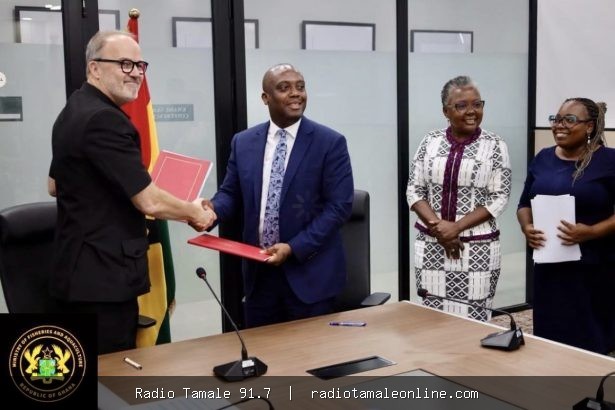
She made the remarks at the signing of a Memorandum of Understanding (MoU) for the Oceans for Development Programme, a collaborative initiative between the governments of Ghana and Norway.
“We must address Ghana’s persistent fisheries and oceans data deficit by strengthening scientific research, data collection, digital systems, and institutional capacity to translate data into evidence-based decisions and measurable impact,” she said.
“Our goal must be to build lasting national capacities and demonstrate tangible results that support sustainable fisheries management and effective ocean governance,” she added.
The programme is expected to deepen bilateral cooperation in scientific research, strengthen fisheries and oceans data systems, and improve the institutional capacity required to manage Ghana’s marine resources sustainably.
The MoU was signed at the Conference Room of the Ministry of Finance by the Deputy Minister for Finance, Hon. Thomas Nyarko Ampem, on behalf of the Government of Ghana, and Norway’s Ambassador to Ghana, H.E. Dr. John Mikal Kvistad, representing the Norwegian government.
Data gaps pose a challenge to ocean governance
The initiative places renewed emphasis on the role of scientific information in shaping fisheries policies and supporting decisions on the use and protection of marine resources.
Reliable data is critical to understanding the state of fish stocks, monitoring fishing activities and assessing changes in marine ecosystems. Such information also provides a basis for designing appropriate interventions, evaluating their effectiveness and strengthening compliance with fisheries management measures.
For Ghana, improving the collection, management and application of fisheries data could help public institutions make better-informed decisions and strengthen the evidence underpinning the development of the country’s blue economy.
The programme’s focus on digital systems and institutional capacity also highlights the importance of developing sustainable national systems rather than relying solely on short-term data collection efforts.
Ghana-Norway cooperation
The Oceans for Development Programme reflects the commitment of Ghana and Norway to work together to strengthen scientific research and institutional systems supporting sustainable ocean management.
Through the initiative, the two countries are expected to advance cooperation in generating and managing fisheries and oceans data, while building the capacity of relevant institutions to translate research findings into practical policy decisions.
The emphasis on lasting national capacity is particularly significant, as sustained access to credible scientific information is necessary for effective ocean governance and the responsible management of marine resources.
The initiative is also expected to support Ghana’s broader blue economy ambitions by promoting the sustainable use of ocean resources while strengthening the information systems needed to guide development and conservation efforts.
As the programme progresses, its impact will depend on how effectively the proposed cooperation translates into stronger data collection, improved institutional capabilities and the practical application of scientific evidence in fisheries management and ocean governance.

0 Comments