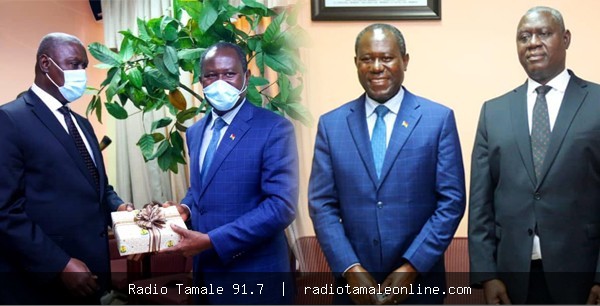
The political controversy surrounding Chief Justice Paul Baffoe-Bonnie’s recent comments on the performance of some state institutions has taken a new turn, following the resurfacing of a 2020 visit by former Chief Justice Kwasi Anin-Yeboah to the Ghana Cocoa Board (COCOBOD), during which he openly commended the management of the institution and its Chief Executive Officer.
Justice Baffoe-Bonnie has come under sustained criticism, particularly from the opposition New Patriotic Party (NPP), following comments he made during outreach visits to state institutions, including the Social Security and National Insurance Trust (SSNIT) and the Minerals Income Investment Fund (MIIF).
A video circulating on social media captures the Chief Justice making comparative remarks about the recent performance of some state institutions, particularly those that have reported improved financial results.
“Sometimes when we hear how well some state organizations are doing now, we wonder what we really have been doing in the past eight years,” the Chief Justice is heard saying.
According to reports, the Chief Justice said: “If the old man has decided that you are the right person to be in this position out of the 30 million people, it means he has a lot of confidence in you. And so we should do everything to make sure that his agenda succeeds.”
He was referring to President Mahama’s development agenda, adding that the President’s agenda would benefit Ghana. The “old man” reference and the call for officials to help ensure the President’s agenda succeeds have become a major part of the political controversy surrounding his remarks.
The comments triggered a political backlash from the NPP, which described them as partisan and inconsistent with the political neutrality expected of the head of the Judiciary.
However, critics of the NPP’s position have pointed to the October 2020 visit by Justice Anin-Yeboah to COCOBOD as evidence that visits by serving Chief Justices to state institutions and public commendations of their officials are not entirely new.
During the visit to the COCOBOD headquarters, Justice Anin-Yeboah praised the then Chief Executive, Joseph Boahen Aidoo, for what he described as his leadership and efforts to improve the living standards of cocoa farmers.
A publication dated October 16, 2020, and posted on the official Facebook page of Ghana Cocoa Board (COCOBOD) reported that the Chief Justice had paid a courtesy call on Mr Aidoo and held engagements with members of the Board’s management.
Justice Anin-Yeboah described COCOBOD’s work in managing Ghana’s cocoa industry as laudable.
“The farmer is also better off because I could see the inputs which have trickled down to the smallest cottage you can think of; I am really glad,” he stated.
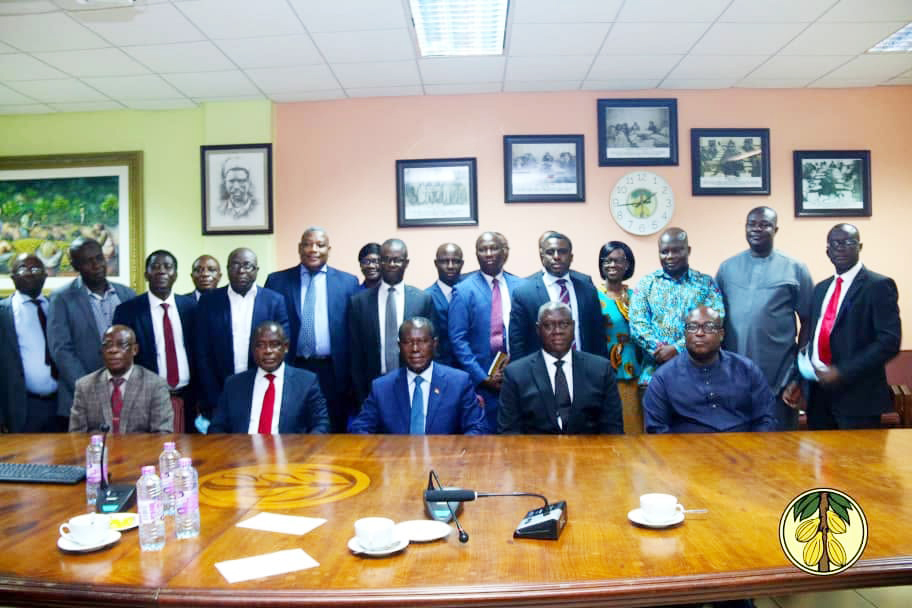
The former Chief Justice, who described himself as a proud son of a cocoa farmer, also disclosed that cocoa farming was a longstanding tradition in his family.
He said he regularly visited his cocoa farm and intended to return to farming full-time upon his retirement from the Bench.
“Every fortnight, I have to go and visit my cocoa farm. I enjoy farming and what I treasure most is when you see the cocoa trees growing. I cannot just stay away from that,” Justice Anin-Yeboah said.
“When I retire, I want to go back to the work which has sustained my livelihood and my family at large.”
He further urged the management of COCOBOD to continue working towards the development of the country.
“Whatever we do is for the common good of this country. Nobody can leave Ghana better than us. We can make or unmake this country and your contribution as the Chief Executive of the backbone of the economy matters a lot,” he said.
“I pray that God should bless us, so that he gives you all what it takes for you to deliver your mandate.”
Responding, Mr Aidoo described the visit as a privilege and thanked the Chief Justice for the honour and encouragement.
“We are most grateful,” the then COCOBOD boss said.
“It inspires us to do better than we are doing. You have come to ginger us to do better. You sit afar and follow our exploits and for you to come here and commend us, we are very grateful. We thank you for this historic visit.”
The resurfacing of the 2020 visit has generated renewed debate about whether Justice Baffoe-Bonnie’s visits to state institutions and his favourable comments about their performance should necessarily be interpreted as political conduct.
The comparison has also attracted particular attention because Justice Anin-Yeboah’s commendation of COCOBOD came at a time when the administration of former President Nana Addo Dankwa Akufo-Addo was prosecuting former COCOBOD Chief Executive Dr Stephen Kwabena Opuni and businessman Alhaji Seidu Agongo in a case involving allegations of causing financial loss to the state.
The case, which involved allegations relating to financial transactions running into millions of Ghana cedis, was presided over by Justice Clemence Honyenuga, who was then a Justice of the Court of Appeal and later became a Justice of the Supreme Court.
Meanwhile, the Judicial Service has formally defended Justice Baffoe-Bonnie’s recent comments, insisting that they were made in good faith and were not intended to undermine the independence of the Judiciary.
In a statement issued on Friday, September 4, 2026, the Judicial Service said the Chief Justice had taken note of the mixed public reaction to observations he made during outreach engagements with some state-owned entities.
“The observations were made in good faith, and were not intended to serve a purpose inimical to judicial independence,” the statement said.
The Judicial Service said the Chief Justice remained committed to upholding the integrity and independence of the Judiciary and promoting justice and equality before the law.
But the explanation has not satisfied the NPP, whose Deputy General Secretary, Haruna Mohammed, has reiterated calls for Justice Baffoe-Bonnie to retract the comments, apologize or resign.
Speaking on The KeyPoints on September 5, Mr Mohammed argued that the Chief Justice’s comments suggested an unusual degree of admiration for President John Dramani Mahama and his administration.
“The Chief Justice must retract and apologize or resign and be sent to the Council of State,” Mr Mohammed said.
“A former Chief Justice has resigned, and there is a vacancy there.”
Mr Mohammed cited provisions of the Constitution, the Code of Conduct for Judges and other legal instruments in support of his argument that the Chief Justice had erred.
“If you did not see the video, you will think that he is an NDC communicator who has been tasked to go and praise the President,” he stressed.
The NPP has described the Chief Justice’s comments as deeply troubling and inconsistent with his constitutional responsibilities.
The party argued that the head of the Judiciary must remain above partisan politics and questioned whether Justice Baffoe-Bonnie could continue to be perceived as impartial in cases involving members of the NPP or matters connected with the current government.
It cited Articles 125 and 127 of the 1992 Constitution, which deal with judicial power and the independence of the Judiciary, as well as the judicial oath requiring judges to administer justice without fear, favour, affection or ill will.
According to the party, the remarks form part of what it considers a broader pattern of conduct capable of undermining public confidence in the political independence of the Judiciary.
The NPP also took exception to an alleged statement attributed to the Chief Justice that “everything must be done to ensure that the agenda of the President succeeds”.
It questioned what such a declaration could mean for accused persons appearing before the courts in matters linked to the government’s Operation Recover All Loot (ORAL) initiative.
The party argued that because ORAL forms part of the government’s agenda and some persons associated with the NPP are facing proceedings connected to the initiative, any perceived alignment between the Judiciary and the Executive could affect public confidence in the fairness of such cases.
“The Chief Justice’s constitutional obligation is to the 1992 Constitution and not to the President, the governing party or any government programme,” the NPP maintained.
The party further criticized the condition of court infrastructure across the country, alleging that several court facilities and judicial offices required urgent rehabilitation.
Contrasting those challenges with what it described as the Chief Justice’s increasing participation in engagements involving government ministries, departments, and agencies, the party declared:
“With respect, My Lord, the leaking roofs are in your courts, not in the ministries.”
The NPP is demanding an immediate and unequivocal withdrawal of what it describes as partisan political comments and the alleged pledge of support for President Mahama’s agenda.
It said that should the Chief Justice decline to do so, he should resign and openly join the governing National Democratic Congress (NDC).
The party has also urged President Mahama to fill the vacant Council of State position and publicly clarify any arrangements concerning the Chief Justice’s possible post-retirement role.
The statement, signed by NPP General Secretary Justin Kodua Frimpong, stressed that the Judiciary belongs to the people of Ghana and must remain independent of political influence.
The latest controversy has also revived memories of the political debate surrounding Justice Clemence Honyenuga when he publicly praised former President Akufo-Addo and suggested that Ghanaians could consider giving him another term in office.
Justice Honyenuga, who was also the Paramount Chief of the Nyagbo Traditional Area under the stool name Torgbui Ashui Nyagasi V, came under intense criticism after making the remarks during President Akufo-Addo’s tour of the Volta and Oti regions.
“We wish to congratulate you for the excellent manner you are governing this dear country of ours, Ghana, and the significant gains made in the economy in your first term,” Justice Honyenuga said at the time.
He particularly praised the Free Senior High School programme, describing it as unprecedented.
“Your Free SHS programme is unprecedented in the history of Ghana, in a first term, as it covers the whole country,” he said.
Justice Honyenuga subsequently expressed the hope that President Akufo-Addo would be given another term.
“It is our hope that with your vision and the gains made in your first term, Ghanaians may consider giving you another four years,” he said.
At the time, the then-ruling NPP defended Justice Honyenuga, arguing that his role as a traditional ruler should not be confused with his judicial duties and insisting that his independence as a judge related principally to his decisions in court.
The then opposition NDC, however, strongly disagreed and condemned the comments as a violation of the Judicial Code of Conduct.
The NDC Volta Regional Secretariat argued that the conduct struck at the sanctity and political independence of the Judiciary.
Justice Honyenuga later apologized during his vetting by Parliament’s Appointments Committee following his nomination to the Supreme Court.
He told legislators that the comments did not reflect his personal political views and explained that he had spoken on behalf of the chiefs and people of the area.
According to him, the intention had been to wish President Akufo-Addo well rather than formally endorse his candidature.
He said that if, because of political dissatisfaction, some people were unhappy with what he had said, “then I am sorry”.
Justice Honyenuga also maintained that judges do not determine cases through political lenses but decide matters based on their merits and the evidence presented before them.
The Honyenuga controversy was particularly significant because he was the judge presiding over the criminal trial involving the State, former COCOBOD Chief Executive Dr Opuni, and businessman Seidu Agongo.
The two defendants repeatedly accused Justice Honyenuga of bias, allegations he denied.
With Justice Anin-Yeboah’s 2020 visit to COCOBOD now resurfacing, the controversy over Justice Baffoe-Bonnie’s comments has expanded beyond the immediate political row to a broader debate about the extent to which serving Chief Justices may engage state institutions, publicly assess their performance and commend public officials without creating perceptions of political alignment.
For critics of the current NPP position, the Anin-Yeboah visit raises questions about consistency in the application of standards of political neutrality to members of the Judiciary.
For the NPP, however, the central issue remains the nature and context of Justice Baffoe-Bonnie’s comparative comments about the performance of state institutions under the current administration and the previous government.
The debate is therefore likely to continue as both sides invoke previous conduct by senior members of the Judiciary to support sharply different interpretations of judicial independence and political neutrality.



0 Comments