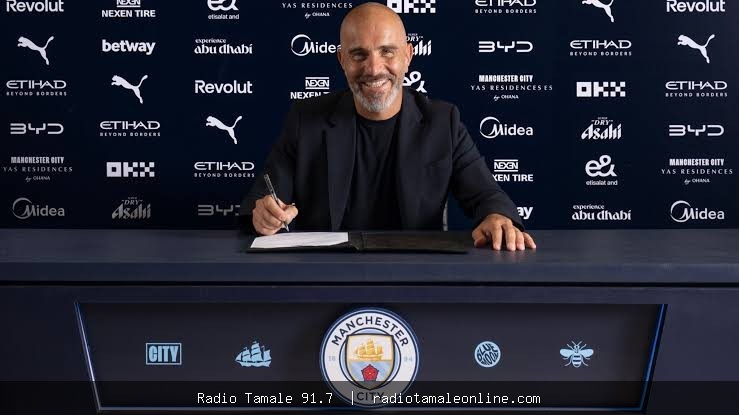
Enzo Maresca steps from the shadow into the light at Manchester City at a moment when shadows are long and expectations longer. After Pep Guardiola’s decade of reinvention, silverware and style, Maresca inherits more than a squad. He inherits a standard and the question that murmurs around the Etihad is simple and sharp, can he carry on where Pep left off?
Maresca arrives with an unusual blend of continuity and ambition. He is not an outsider parachuted in to stamp a new identity; he is a product of the same coaching bloodstream that has made City synonymous with controlled chaos, positional intelligence and near-obsessive preparation. That familiarity is a practical advantage. City’s playing philosophy is not a set of tactics pinned to a board but a culture embedded in training ground routines, staff networks and the DNA of the dressing room. Maresca’s years within Guardiola’s orbit give him fluency in that language, and fluency buys time an invaluable currency when the margin for error is paper-thin.
Yet fluency is not authorship. The step from trusted lieutenant to the man who hangs the tactics on the wall is bigger than many appreciate. Maresca must grow into the role of first-team head coach, asserting his voice while preserving the structure that brought success. This is not about copying Pep, it’s about curating what worked and carefully editing what did not. His managerial fingerprint will matter. How he handles rotation, how he approaches big matches tactically, and how he shoulders media scrutiny when results wobble.
Crucial to that transition are the squad’s pillars. Rodri remains the metronome, his reading of the game and ability to arrest transitions is central to any City plan. Erling Haaland, a walking goal factory, alleviates tactical conservatism by insisting defenses must commit men forward, opening spaces the system thrives on. Ruben Dias provides leadership and stability at the back; his voice will be essential in aligning defenders to Maresca’s demands. Phil Foden, City’s mercurial artist, will test Maresca’s capacity to harness individual brilliance within collective discipline. Josko Gvardiol, with athleticism and ball-playing ability, complements that spine and gives Maresca a modern centre-back option to shape pressing triggers.
Those names create a buffer against teething problems. When elite players buy into a coach’s plan, transitions accelerate. Maresca’s early task is not to reinvent but to persuade, convince leaders like Dias and Rodri to act as extensions of his tactical brief, and to keep Foden and Haaland engaged without smothering their instincts.
Realistic expectations for Maresca’s first season should be measured. City’s appetite for titles is ravenous, but a complete replication of Guardiola’s trophy haul in year one is unlikely. Expect sustained competitiveness across competitions.Title challenges, deep runs in the Champions League, and domestic cup contestation. Fans should hope for stability, clear identity on the pitch, and a team that adapts rather than collapses under pressure. Patience will be the reward for stakeholders who allow Maresca tactical latitude to imprint his approach.
The three-year contract City offered speaks volumes. It signals faith, not complacency. The club’s hierarchy appears willing to back a plan that balances short-term results with medium-term continuity. That length suggests they view Maresca as a prospect for a project, not a stopgap an endorsement that buys him time to cultivate his methods, integrate youth and imprint his culture without the looming threat of instant dismissal.
New signings such as Elliot Anderson and Jeremy Monga bring depth and profile to Maresca’s toolbox. Anderson’s dynamism and versatility offer fresh attacking options; young, hungry additions can be vital in rotation-heavy campaigns. Their presence also lets Maresca experiment with phases and personnel in less costly arenas—cup games and rotational fixtures, where philosophy can be trialed without catastrophic consequence.
Ultimately, Maresca’s success will hinge on two things: how quickly he secures the dressing room’s conviction and how intelligently he adapts the City model to his own managerial temperament. If he blends the inherited blueprint with subtle personal innovations, and if City’s core stars remain fit and engaged, the transition need not be a rupture. It may instead be the next chapter in a club defined by evolution, a new voice at the helm, steering a familiar ship through familiar seas, toward new horizons.
By: Addy Kennedy Edem








0 Comments