

Escalating geopolitical tensions in the Middle East, triggered by coordinated strikes by the United States and Israel on Iran in late February, have persisted into March, with far-reaching implications for global energy markets.
Disruptions to shipping activity through the Strait of Hormuz have tightened supply and heightened volatility in crude oil prices, with Brent crude at some point surpassing $100 per barrel.
For import-dependent economies such as Ghana, the pass-through effects were largely anticipated.
Ahead of the second pricing window of March, which commenced on March 16, projections by the Chamber of Oil Marketing Companies (COMAC) indicated significant increases in ex-pump prices, with petrol, diesel and LPG expected to rise by 16.93 percent, 17.21 percent and 11.26 percent respectively.
The projected hikes were driven primarily by the surge in global crude prices and supply constraints linked to the Middle East crisis.
Consequently, most Oil Marketing Companies adjusted their pump prices upward at the start of the pricing window, in line with prevailing market conditions.
However, the full impact of these increases on consumers has been partially cushioned, as intensified competition among OMCs has moderated the pace of price adjustments at the pumps.
Star Oil and GOIL trigger price war
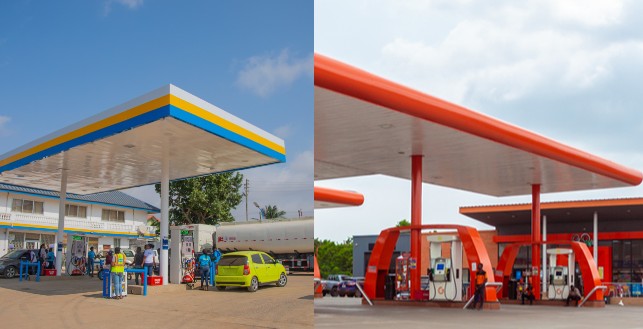
Competition between Star Oil and GOIL intensified at the onset of the second pricing window in March, setting off a rapid sequence of price adjustments across key petroleum products.
State-owned GOIL initially maintained prices at the National Petroleum Authority’s price floor for the pricing window, offering petrol at GH¢11.57 per litre and diesel at GH¢14.35 at the start of the March 16 window.
This positioned GOIL below market leader Star Oil, which had adjusted its prices upward in response to rising global oil prices.
At the beginning of the window, Star Oil priced petrol at GH¢12.49 per litre, diesel at GH¢15.99, and RON 95 at GH¢13.59.
The pricing gap, however, proved short-lived.
By March 17, GOIL revised its prices, with petrol selling at GH¢12.40 per litre and diesel to GH¢15.69, while Super XP 95 was maintained at GH¢14.35.
In a swift competitive response, Star Oil adjusted its prices downward the same day, cutting petrol to GH¢12.29 per litre and diesel to GH¢14.99, effectively undercutting GOIL on the two most consumed products.
GOIL reacted within hours, revising its prices downward to regain a marginal edge. Petrol was reduced to GH¢12.28 per litre and diesel to GH¢14.98, narrowly below Star Oil, while Super XP 95 remained unchanged at GH¢14.35.
The pricing contest extended into subsequent days. On March 20, Star Oil further trimmed its petrol price to GH¢12.25 per litre, retaining a slight advantage over GOIL’s earlier pricing.
However, it raised diesel prices to GH¢15.79 per litre, moving above GOIL’s levels, while RON 95 increased to GH¢14.25, still marginally below GOIL’s Super XP 95.
GOIL’s March 21 adjustments reflected a mixed pricing strategy. Petrol prices were reduced slightly to GH¢12.24 per litre, reinforcing its competitiveness on that product, while diesel prices increased to GH¢15.69 per litre, slightly below Star Oil’s diesel prices of GH¢15.79 per litre. GOIL’s Super XP 95 price remained unchanged.
The sequence of adjustments highlights an increasingly dynamic and competitive pricing environment, with both firms actively recalibrating their strategies in response to each other and prevailing market conditions.
Competitive pressure spreads across the market
In response to the intensifying price competition between the market leaders, other Oil Marketing Companies begun recalibrating their pricing strategies to maintain competitiveness.
TotalEnergies and Shell have kept petrol prices unchanged at GH¢13.29 per litre but adjusted diesel prices downward from GH¢16.29 to GH¢15.89 per litre, reflecting selective price moderation in response to market pressures.
Petrosol has adopted a similar approach, holding petrol prices steady at GH¢13.25 per litre while reducing diesel prices from GH¢16.25 to GH¢15.98 per litre.
These adjustments point to a broader shift in the downstream petroleum market, where OMCs are increasingly balancing margin preservation with the need to remain competitive in a price-sensitive environment.
Market share battle and regulatory constraints
GOIL’s pricing strategy appears aligned with efforts to reclaim market leadership, leveraging its extensive nationwide network of over 400 outlets. Star Oil, which overtook GOIL in market share in the first half of 2025, continues to rely on competitive pricing to sustain its lead.
The rivalry has intensified following the enforcement of revised petroleum pricing guidelines, which mandate uniform pricing across outlets and effectively eliminate targeted fuel price discounts at selected outlets.
This regulatory shift has removed a key competitive tool previously used by OMCs, forcing players to compete more directly on headline pump prices.
At the same time, calls are growing for a review of the price floor policy to allow greater flexibility for OMCs to pass on cost savings to consumers. The regulator maintains that the price floor is necessary to prevent predatory pricing, though it remains open to stakeholder engagement
Currency pressures and consumer impact
Beyond the ongoing price competition, exchange rate movements remain a key determinant of fuel price trends in Ghana, particularly in the context of heightened geopolitical tensions.
Data from the Bank of Ghana indicates that the cedi has weakened against the US dollar since the start of 2026, depreciating by 4.6 percent in January, 2.2 percent in February and 3.9 percent in March. This sustained pressure on the local currency could drive up the cost of imported petroleum products.
However, industry data from the Chamber of Oil Marketing Companies shows that within the March 16 pricing window, the cedi recorded a marginal appreciation, strengthening from GHS 11.049 to GHS 10.913 to the dollar, representing a 1.25 percent gain.
While this provided some temporary relief, the broader trend underscores ongoing currency vulnerability.
Maintaining relative stability of the cedi against major trading currencies will be critical in moderating the pass-through effects of global oil price shocks on domestic pump prices.
Policy options and long-term energy security
Rising fuel costs have renewed discussions around possible government interventions, including temporary tax reliefs on petroleum products.
The sustainability of levies such as the GHȼ1 fuel levy introduced under lower price regimes is increasingly being questioned in the current high-price environment.
Over the longer term, Ghana’s exposure to external shocks continues to highlight the need for energy security.
Expanding local refining capacity through facilities such as the Tema Oil Refinery and Sentuo, alongside building strategic reserves through BOST, remains critical to reducing dependence on imported refined products.
Until these structural gaps are addressed, Ghana’s downstream petroleum sector will remain highly sensitive to global geopolitical developments, with domestic price stability closely tied to events far beyond its borders.