

Accra, Ghana – October 8, 2025:
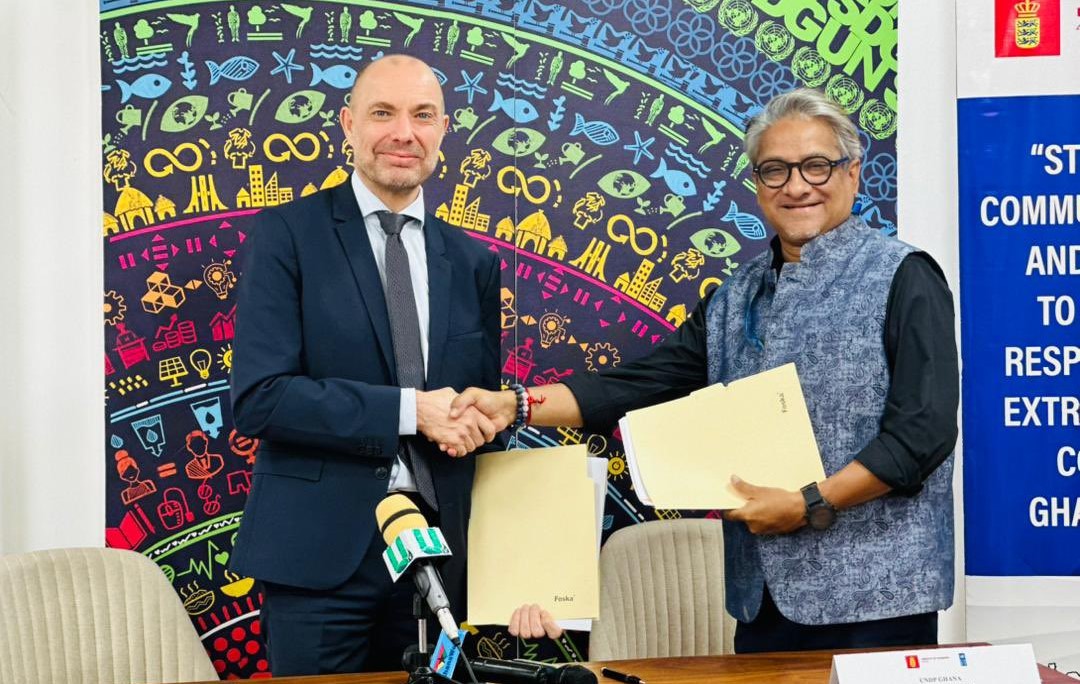
The Government of Denmark, through its Embassy in Accra, has renewed its commitment to peace and stability in West Africa by partnering with the United Nations Development Programme (UNDP) to launch Phase II of the Atlantic Corridor Project.
The initiative, titled “Preventing and Responding to Violent Extremism in the Atlantic Corridor,” seeks to counter radicalisation and strengthen community resilience across Benin, Côte d’Ivoire, Ghana, and Togo.
Under the new agreement, Denmark will provide DKK 30 million (approximately USD 4.6 million) in funding for the second phase, which runs from 2025 to 2028.
The support forms part of Denmark’s Peace and Stabilisation Programme for West Africa (2025–2028), aimed at promoting inclusive development and sustainable peace in the subregion.
Speaking at the signing ceremony in Accra, Jakob Linulf, Denmark’s Ambassador to Ghana, emphasised that the initiative represents Denmark’s broader efforts to combat instability and terrorism, both of which pose shared threats to Africa and Europe.
“Instability and terrorism are common challenges for Africa and Europe. Denmark’s new partnership with UNDP to prevent the spread of violent extremism in the border areas of the coastal states is an important part of our wider engagement for peace and stabilisation in West Africa,” Ambassador Linulf said.
The new phase builds on the success of Phase I (2023–2025), which received DKK 10 million in Danish funding. That phase successfully established 50 community-level conflict early warning and response mechanisms, increasing awareness of violent extremism prevention among targeted beneficiaries from 23% to 97%.
It also provided livelihood and vocational skills training to over 1,699 at-risk youth and women, helping reduce their vulnerability to extremist recruitment.
A mid-term evaluation by the Danish Ministry of Foreign Affairs praised the initiative for its measurable impact and potential for scale-up, leading to the design of Phase II to deepen community engagement, strengthen coordination with national and regional counter-extremism frameworks, and expand early warning networks.
According to UNDP Resident Representative Niloy Banerjee, the partnership demonstrates how global collaboration can empower local communities to withstand extremist threats.
“In the face of the threat of violent extremism, we recognise that this partnership, and many others in the pipeline, will help amplify local voices, share knowledge, enhance early warning systems, and build community resilience to counter the influence of violent extremists,” Mr. Banerjee noted.
The Atlantic Corridor Project adopts a regional, community-centred approach, tackling the root causes of radicalisation such as youth unemployment, inequality, and governance gaps. It promotes peace, tolerance, and socio-economic inclusion while combating hate speech and misinformation.
Through this renewed collaboration, Denmark and UNDP reaffirm their shared commitment to advancing peace, stability, and inclusive growth across West Africa’s coastal and border communities, ensuring that local solutions remain at the heart of regional resilience efforts.